When Your Planned Home Birth Ends in the Hospital: Grieving the Birth You Didn't Get
If you are reading this in the quiet hours of your baby napping or feeding and wondering why your birth story still feels so heavy, this blog is for you. When you spend nine months planning and prepping for a holistic, physiological, unmedicated delivery, only to experience a hospital transfer from a planned homebirth, the emotional pain is profound.
You might be scrolling through social media, seeing other moms post about their empowering, candlelit water births, and feeling a sharp sting of jealousy or sadness. You might be silently asking yourself, why didn't my body do that?
Mourning the home birth you didn't get is a specific, deeply painful type of grief. Often called disenfranchised grief. And unfortunately, it is a grief that is often silenced by the well-meaning but dismissive phrase, "At least you have a healthy baby." Today, we are going to talk about why grieving my birth plan is completely normal, and how to begin healing from a lost physiological birth.
Why Grieving Your Birth Plan is Completely Normal
When a planned home birth ended in the hospital, the trauma isn't just about the medical procedures that happened to your body. It is also about the profound loss of body autonomy, the sudden shift in environment, and the shattering of a vision you held closely for nearly a year or more.
As a first-time mom, you likely read the books, hired the midwife, practiced hypnobirthing, and did everything "right" to set yourself up for success. You built a safe, sacred space in your mind and your home. When that plan was interrupted by an emergency or a prolonged labor that required a hospital transfer, your nervous system went into survival mode.
It is incredibly common to feel disappointment when birth doesn't go as planned. You are not ungrateful for your baby's safe arrival. You are simply a human being processing a massive shock to your nervous system. You are allowed to hold deep gratitude for your child's life while also grieving and hating the traumatic way they entered the world. Two things can be true at the exact same time. As you allow these seeming contradictions to co-exist, you will begin to gain a deeper understanding within yourself.
The Reality of a Hospital Transfer from Planned Homebirth
Transitioning from the quiet intimacy of your home or birth center into the bright lights, monitors, and clinical protocols of a hospital room is a huge shift for a laboring mother. You went from feeling completely in control of your environment to feeling like another patient on the hospital’s timeline.
Processing grief after unexpected interventions whether that was Pitocin, an epidural you didn't want, or an emergency C-section takes time. Your mind and body are trying to reconcile the birth you prepared for with the highly medicalized birth you actually experienced. It is okay if you feel angry. It is okay if you feel disconnected. These are normal responses especially if your birth or postpartum experience was traumatic.
Healing from a Lost Physiological Birth
So, how do you begin to move forward when you feel stuck in the loop of what if and if only? Healing from a lost physiological birth requires intentionality and self-compassion. Here are three steps to help you begin navigating the grief of your birth plan:
First, you must give yourself permission to grieve. Stop fighting the sadness, anger, and disappointment. These emotions are not bad. They are signaling that something deeply important was taken from you. Many people may tell you to ‘give it time’ but time alone doesn’t automatically heal grief from a traumatic birth. Dedicating a specific, contained time of day to journal your feelings can help externalize the pain. Start by imagining a dear friend who experienced the exact same birth you did. What would you say to them? What words would you choose to honor and validate their pain? Direct that same fierce compassion inward.
A quick note before you begin journaling: if you’re healing from a traumatic birth, try to avoid rewriting your entire birth story all at once without support, as this might be overwhelming or even re-traumatizing. You may find yourself struggling with the grief and a great urge to ‘tell the story’ to find someone willing to hear what others cannot, and to make sense of your birth story without the awkward silence or the ‘silver lining’ advice. Sharing your story in a safe, non-judgmental space is profoundly healing, but working through intense trauma triggers is always best done alongside a licensed therapist trained in perinatal mental health and trauma modalities like EMDR.
Second, anchor yourself in the moment safety returned. Take some time to reflect on or journal about the exact moment you began to feel safe again. Was it when you finally made it home and walked through your own front door? Was it the moment you and your baby were finally reunited after being separated? Gently notice the physical details of that moment, when your shoulders dropped, your breathing slowed, and even a small sense of ease returned to your body. Teaching your nervous system to recognize that the threat is over is a crucial part of trauma recovery.
Third, practice self-compassion. When a planned home birth ended in hospital, it is easy to feel like your body failed. But look at what you did: you made an impossible, terrifying pivot. You had such courage to surrender your dream birth to ensure you and your baby's safety. You walked into the exact environment you feared most and made it through anyway. That is not failure. That is the fiercest form of maternal strength.
Your birth story matters, your trauma is valid, and your healing journey is just beginning. If you are struggling to process your birth experience, you do not have to go through it alone. You deserve a supportive space to heal and grow into the mother and woman you are created to be.
At Worthy To Live Therapy, we specialize in helping mothers heal from childbirth trauma using evidence-based approaches that actually transform how your body holds the memory.
Ready to take the next step?
•Read more about navigating postpartum mental health and trauma on The Therapist's Journal.
•Reach out to schedule a free 1:1 consultation and begin your healing journey at Worthy To Live Therapy.
Author Bio:

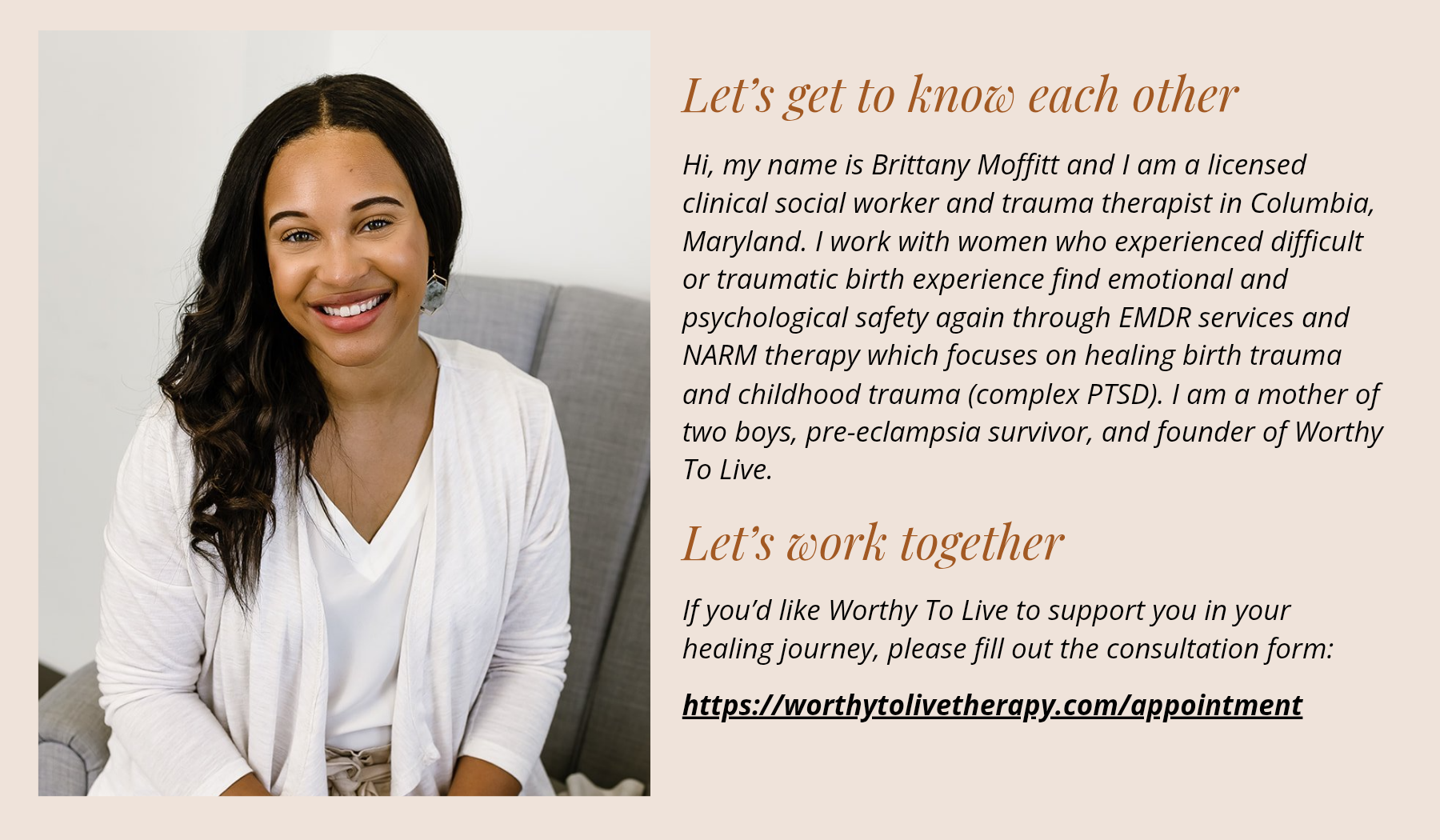
Brittany Moffitt is a licensed clinical social worker based in Columbia, Maryland. She is the founder of Worthy To Live Therapy, a private practice specializing in trauma and maternal mental health for women. She is a mama of two boys and a pre-eclampsia survivor.
Stay connected for more resources on birth trauma, postpartum mental health, and motherhood:
📱Instagram: @worthytolivetherapy
💻Facebook: https://www.facebook.com/BrittanyMoffittLICSW
Medical Disclosure: All advice given on this site is general and does not pertain to individual situations. Please speak with your medical provider about specific concerns and conditions you may have.