
Struggling to Bond with Baby After a Traumatic Birth? Here’s what you need to know.
"I don’t feel like my baby’s ‘mine.’ I feel like my baby’s a stranger." If you’ve noticed yourself carrying any of these thoughts, it can feel alarming or even shameful. Many mothers quietly feel guilt and overwhelm because they did not instantly bond with their baby as they hoped they would. What society does not tell mothers is how common it is for bonding to be delayed especially after a traumatic birth experience. What isn’t talked about enough is the reality of a sense of postpartum detachment from their newborn that many mothers experience. The good news is that although bonding may be delayed for you right now, it doesn’t mean it will never come. With the right support and an understanding of what you’ve been through and what you’re currently going through, it helps to meet these thoughts with curiosity and self-compassion while also integrating techniques that encourage bonding. My hope is that by the end of this blog, you will find practical tips for strengthening your bond with your baby, along with next steps to heal any distress that is getting in the way of bonding.
At Worthy To Live Therapy, we want you to hear this clearly: Delayed bonding is not your fault, and it is not a sign that you are a bad mother. In fact, you’re an amazing mother to even be looking this up and trying to understand what is going on. This shows that you care deeply and you love your baby. This difficulty bonding is not due to something you’re doing wrong, rather it’s your body’s response to an overwhelmed nervous system. When you experience birth trauma and bonding issues, your body is simply trying to protect you from being any further overwhelmed, so it may be shutting down, numbing out, or distancing.
Why Birth Trauma Causes Difficulty Bonding with Baby
Understanding the "why" is the first step toward healing. When a birth is difficult or traumatic, the brain’s survival center (the amygdala) takes over. This can lead to several responses that interfere with maternal-infant attachment, in other words, the mom and baby connection.
Emotional Numbness: Your system may "shut down" to protect you from the overwhelming emotions of the birth, making it hard to feel the "spark" of connection.
Hyper-vigilance: If you are constantly scanning for danger, your nervous system cannot enter the relaxed state required for deep bonding.
Dissociation (freeze response): Feeling like your baby feels like a stranger is often a form of dissociation, a way for your mind to distance itself from a situation that feels unsafe.
These are common signs of postpartum PTSD and bonding struggles. Your brain is prioritizing survival and in doing so, it’s having a hard time to tune into your baby’s cue or find connection in the present moment.
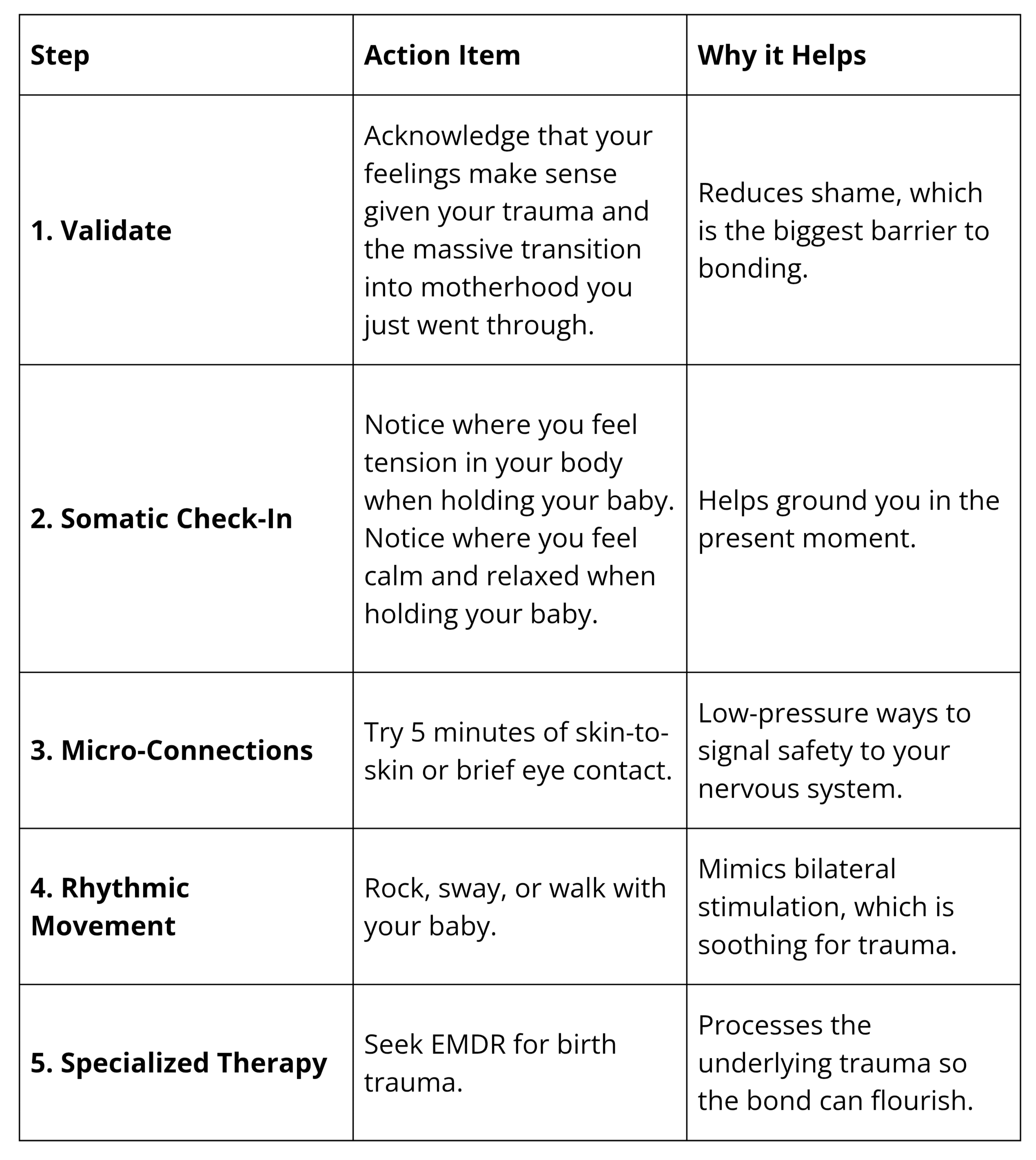
5 Trauma-Informed Steps to Bond with Your Baby
If you are struggling to bond with baby, you don't have to force a feeling that isn't there yet. Instead, you can focus on creating a sense of safety that allows connection to grow naturally over time because it will!
Healing Maternal-Infant Attachment After Trauma
Healing the bond with your baby is a journey of birth trauma recovery. You are essentially teaching your nervous system that the "danger" of the birth is over and that it is safe to connect with your baby and be present in the moment. This process cannot be rushed, but it can be supported.
How to Bond with Baby After Traumatic Birth: Practical Tips
Focus on the Senses: Instead of trying to "feel love," focus on what you see, smell, or feel. The scent of your baby’s head or the weight of them in your arms are sensory anchors. This is great to try during bath time or bedtime reading.
Lower the Stakes: You don't need to feel a "rush" of love every second. Acknowledge the quiet, neutral moments as progress.
Notice when your ‘inner critic’ is loud: If you begin to judge yourself or pressure yourself to have quickly, it’s okay to respond to your thoughts by saying, “I am learning to bond with my baby, my healing takes time, and there is still plenty of opportunities to deepen my connection with my baby’ or ‘This moment does not define me as mother’.
When to Seek Help for Postpartum Detachment
If you find that the feeling of postpartum detachment from your newborn is accompanied by intense anxiety, intrusive thoughts, or a total inability to care for yourself or your baby, please reach out for professional support.
At Worthy To Live Therapy, we specialize in EMDR for birth trauma and NARM-informed therapy for complex PTSD. We help you process the traumatic memories of your birth so your nervous system can finally "down-regulate" and help you to connect back to yourself. You are worthy of healing, and you are Worthy To Live an abundant life of peace and connection with your child.
Ready to start your healing journey? [Book a free consultation today] https://worthytolivetherapy.com/birth-trauma
References
16 ways to bond with your baby
4 Postpartum Support International: Mother-Infant Bonding
5 PMC: Childbirth-related PTSD and Bonding
6 Birth Trauma Association: Seeking Professional Help