
Birth Trauma Recovery: How to Set Boundaries with Family and Friends
Navigating birth trauma recovery can be an incredibly lonely and isolating journey. Many mothers find that even well-meaning loved ones don't fully understand the depth of a traumatic birth experience. It is a common misconception that if the baby is healthy, the mother should be "fine." However, at Worthy To Live Therapy, we know that healing after a difficult birth is a complex process that requires time, patience, and most importantly clear boundaries.
Trauma is deeply subjective. What feels manageable for one person may be a significant trigger for another. Because trauma often lives in the body long after the event, you may find yourself in a constant state of fight or flight, even years postpartum. Setting postpartum boundaries with family and friends is a vital step in reclaiming your sense of safety and autonomy.
Why Setting Boundaries is Essential for Birth Trauma Healing
Boundaries are not about pushing people away; they are about protecting your peace, honoring your healing process, and creating a safe space for yourself to recover. When you are in the midst of birth trauma healing, your capacity to handle social pressure or unsolicited advice is often diminished. By establishing clear limits for yourself, you create a "regulating container" where your recovery can take priority. This guide will help you identify, understand, and communicate the boundaries you need to thrive.
Types of Postpartum Boundaries
To effectively manage your environment, it helps to categorize your boundaries into three main areas:
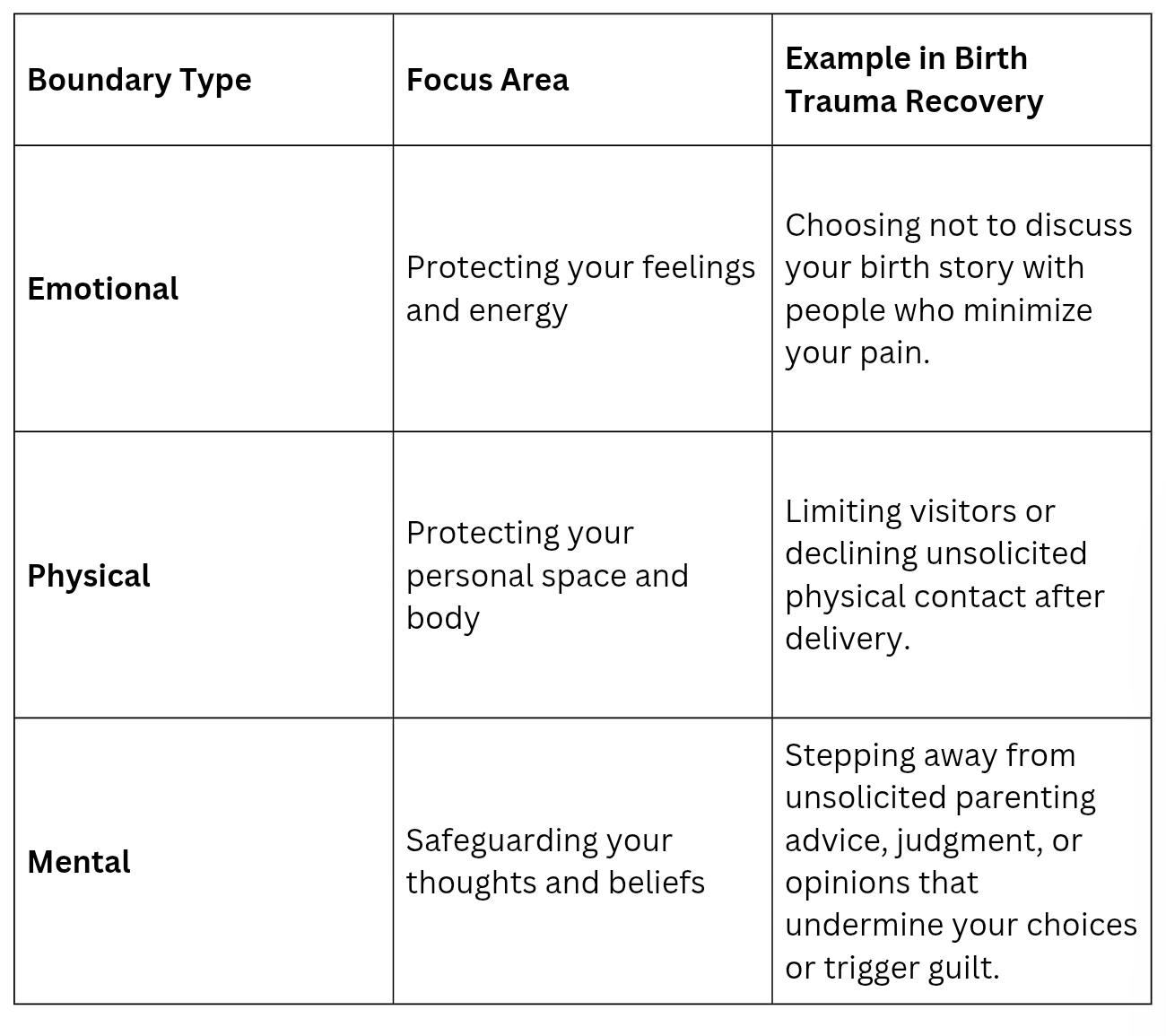
In addition to these, we work with internal boundaries (how you talk to yourself) and external boundaries (what you communicate to others). Both are essential for maintaining peace during your postpartum mental health support journey.
Identifying and Managing Birth Trauma Triggers
A key part of traumatic birth healing is recognizing what sends your nervous system into fight or flight. Common birth trauma triggers often include:
Social Media Announcements: Seeing a friend's pregnancy announcement on Facebook can trigger an immediate "shut down", anger, or a wave of grief.
Family Birth Stories: Hearing relatives recount their own "easy" births can feel invalidating and re-traumatizing.
Baby Showers: These events are often minefields of triggers, from birth-related games to unsolicited advice, which can lead to intense feelings of guilt when you feel unable to participate fully and feel the joy everyone else you may be feeling.
These situations, and countless others, can bring up intense emotions, sending you into a fight or flight response and causing you to shut down. The subsequent guilt that you couldn't be there for your friend or family the way you wanted to is a heavy burden that often accompanies birth trauma.
Your 4-Step Roadmap for Setting Boundaries After Birth
If you are wondering how to talk about birth trauma with family or how to say "no" to social obligations, follow this simple roadmap:
Pinpoint the Trigger: Notice when your heart races or you feel the urge to withdraw.
Define Your Need: Do you need space, silence, or a change of topic?
Choose the Boundary: Decide what limit will protect your peace in that moment.
Communicate Clearly: Use simple, direct language to state your needs without feeling the need to justify them.
Support Scripts for Difficult Conversations
Using "I" statements can help you communicate your needs with grace and firmness. Here are a few examples:
For limiting birth story discussions:
"I'm so happy for you, but I'm finding it hard to hear detailed birth stories right now. Can we talk about something else?"
"My birth experience was really challenging for me, and I'm still processing it. I need to step away from this conversation for a bit."
For managing social events (like baby showers):
"I'm so excited to celebrate with you, but I might need to leave a little early to manage my energy."
"I'd love to come, but I'm taking things slowly right now and need to prioritize my rest. I'll send a gift and be thinking of you!"
For unsolicited advice or comments:
"Thank you for your concern, but I'm following my intuition/my doctor's advice on this."
"I appreciate your perspective, but I'm not looking for advice right now. I just need you to listen."
When you’re met with compassion, you could say: “Thank you for understanding where I am in this healing journey."
Finding Validating Support in Your Healing Journey
Now that we've talked about ways you can set boundaries with your friends, family, and loved ones, I'd also like to invite you to think about or explore: what messages have you found validating or helpful throughout your journey? Has someone become closer to you during this season of your life, or someone who you've relied on more? What about them has been helpful or compassionate for you during this time of your healing journey?
Often, the most supportive people are those who offer:
Presence, Not Solutions: They sit with you in your pain without trying to fix it.
Validation: They affirm your feelings, saying things like, "That sounds incredibly hard," or "It makes sense that you feel that way."
Non-Judgment: They listen without offering unsolicited advice or comparing your experience to others.
Practical, Asked-For Support: They offer specific help (e.g., a meal, watching the baby for an hour) rather than vague "let me know if you need anything."
Identifying these qualities can help you lean into relationships that nourish your healing and reinforce your sense of worth.
At Worthy To Live Therapy, we specialize in EMDR for birth trauma and NARM-informed therapy to help you move from a state of survival to one of thriving. You don't have to carry the weight of your experience alone. If you find yourself struggling to set these boundaries, or if the weight of your birth trauma feels too heavy to carry alone, please know that you don't have to navigate this journey by yourself.
Are you ready to take the next step in your recovery? [Click here to book a free consultation]
Author Bio:

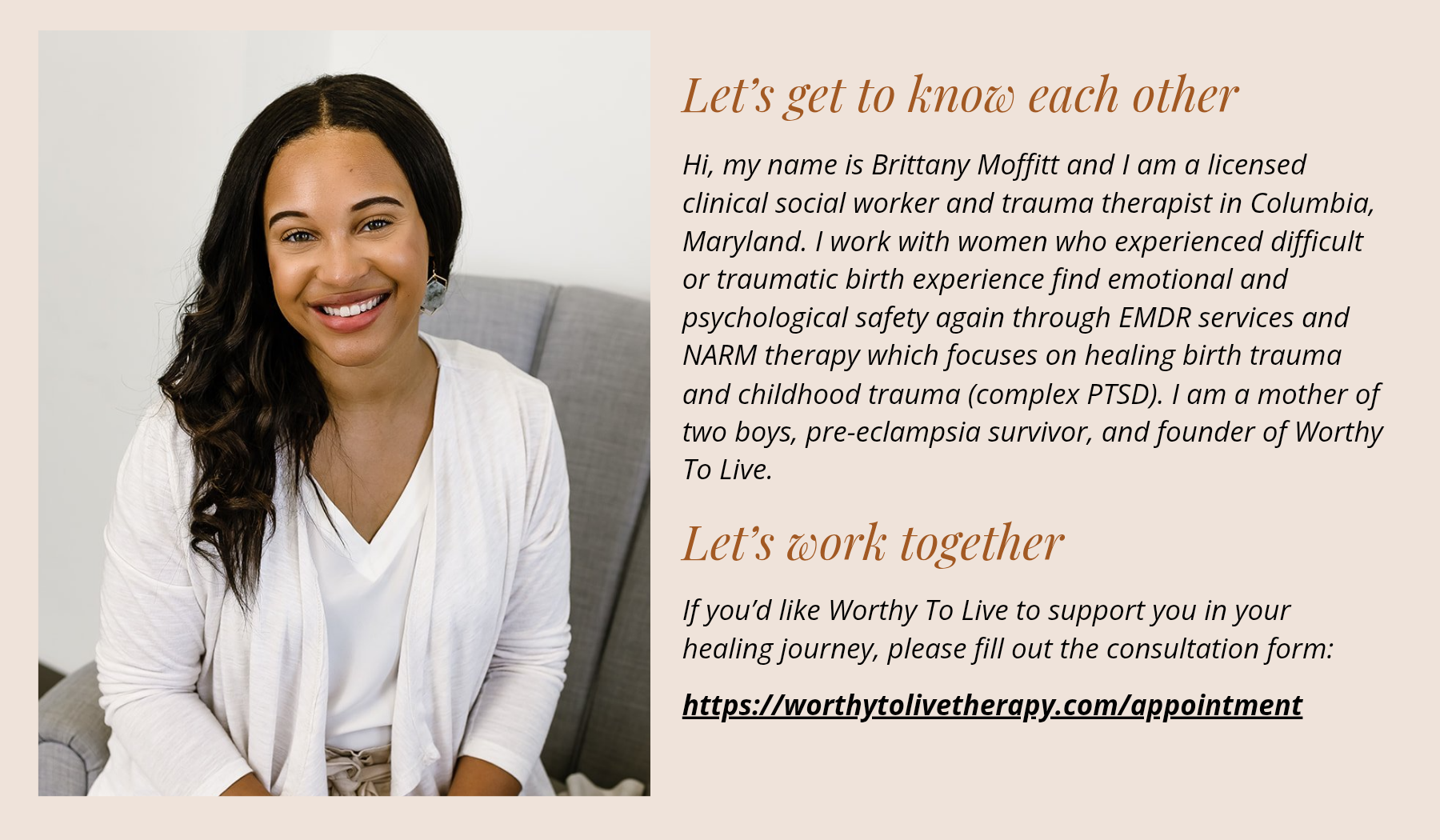
Brittany Moffitt is a licensed clinical social worker based in Columbia, Maryland. She is the founder of Worthy To Live Therapy, a private practice specializing in trauma and maternal mental health for women. She is a mama of two boys and a pre-eclampsia survivor.
Stay connected for more resources on birth trauma, postpartum mental health, and motherhood:
📱Instagram: @worthytolivetherapy
💻Facebook: https://www.facebook.com/BrittanyMoffittLICSW
Medical Disclosure: All advice given on this site is general and does not pertain to individual situations. Please speak with your medical provider about specific concerns and conditions you may have.
____________________________________________________________________________
Resources
Postpartum Support International (PSI)
The National Institute for the Clinical Application of Behavioral Medicine (NICABM) on Trauma