When Other People’s Positive Birth Experiences Hurt
When Other People’s Positive Birth Experiences Hurt
Childbirth Trauma Healing
You were hoping and waiting for the birth of your child, believing that the day would go smoothly, as all mothers do. But when the day your baby arrived came, it went nothing like you expected. Within a matter of hours, minutes, or even seconds, everything changed. A day that should have been a celebration felt more like a struggle for survival and deep disappointment.
And now, you find yourself triggered when you hear other people describe their “easy” or “positive” birth experiences. Because there’s a lot of emotion you are feeling internally. It activates an emotional response in you that may feel like: Anger, Jealousy, Bitterness, Shame, Loneliness or Disappointment. We’ll look at how these emotions developed and what they’re trying to communicate.
This can feel incredibly overwhelming to manage in the moment. If you find yourself avoiding conversations in the breakroom, Facebook posts, or interactions with certain family or friends who recently had a baby, it's an understandable reaction. Your nervous system has learned to stay hypervigilant to anything that might trigger memories of how your birth did not go as planned and the pain you still carry from it.
The “why” behind the feelings
Anger: Feeling anger when you hear other people's positive birth stories makes a lot of sense, especially if yours involved fear, loss of control, pain, or not being listened to. Those stories can bring up anger in you because they're a reminder of what you did not get. Anger is often a protective response. It's a signal that a boundary was crossed or something important was taken from you. This does not mean you're incapable of feeling happy for others; it means your nervous system is reacting to unresolved hurt.
Jealousy/Bitterness: Feeling jealous is actually an understandable response to hearing other people's positive birth stories, especially if yours was difficult or overwhelming. Jealousy or bitterness is a sign that something important mattered to you and that a real loss or unmet need has taken place. A practical way of approaching this is the next time you feel jealous or the impulse to compare, take a moment to notice the emotion and get curious about the information it's trying to give you, rather than jumping to self-judgment or self-shame. It's important to remember that another person's birth experience does not erase or minimize what you experienced. Your birth story matters.
Shame: Our nervous system likes to create a narrative and needs to make sense of what happened. When there’s no clear or satisfying explanation as to why, it often fills in the gaps on it's own. In those moments, you may turn blame or shame inward by having thoughts like: “What’s wrong with me that I had a birth like this?” or “My body failed me”. These thoughts aren't a reflection of truth, and with the right support, you can find safety and understanding from a place of self-compassion and connection.
Lonely: Our culture often pushes for women to feel grateful, happy, and celebratory at the end of all birth experiences, but that’s simply not the case for everyone. Yes, you love your baby but it can be lonely to carry these feelings when no one understands the impact it has on you.
Disappointment: Whether we realize it or not, culture, family upbringing, and our own expectations all play a role in shaping how we approach birth. When our birth experience deviates so vastly from what we expected, there is often a deep sense of disappointment.
I want to remind you that you’re not a bad friend, bad sister, or bad mother for feeling upset or angry by another person’s positive birth story. This is part of the grieving process that no one talks about. Because if you experienced a birth trauma, then you experienced loss. It may have been loss of a sense of safety, loss of trust in your body or the medical providers, loss of the birth you imagined, or loss of parts of yourself that you once felt connected to. Because ultimately, grief can exist without trauma but trauma cannot exist without grief. In therapy, we process it all. Because it is often the grief and anger that drive our triggers and intense anxiety, impacting our ability to fully reconnect with ourselves and others once again.
Here are the three things as a birth trauma therapist I would invite you to unpack to fully find relief from your triggers and peace with your story:
Grieve the experience you didn’t have, process the way you were treated, and unpack what your body went through.
Understand your emotional reactions, triggers, and learn grounding tools to feel like yourself again
Rediscover yourself after birth: Who are you now that you have become a mother? What parts of yourself did you have to shut down in order to cope with the birth trauma?
True healing comes from feeling safe enough to gently understand the weight you’ve been carrying and reconnect with yourself, so your body is no longer in survival mode, and you can actually start enjoying your life again. Because you’re worthy of it!
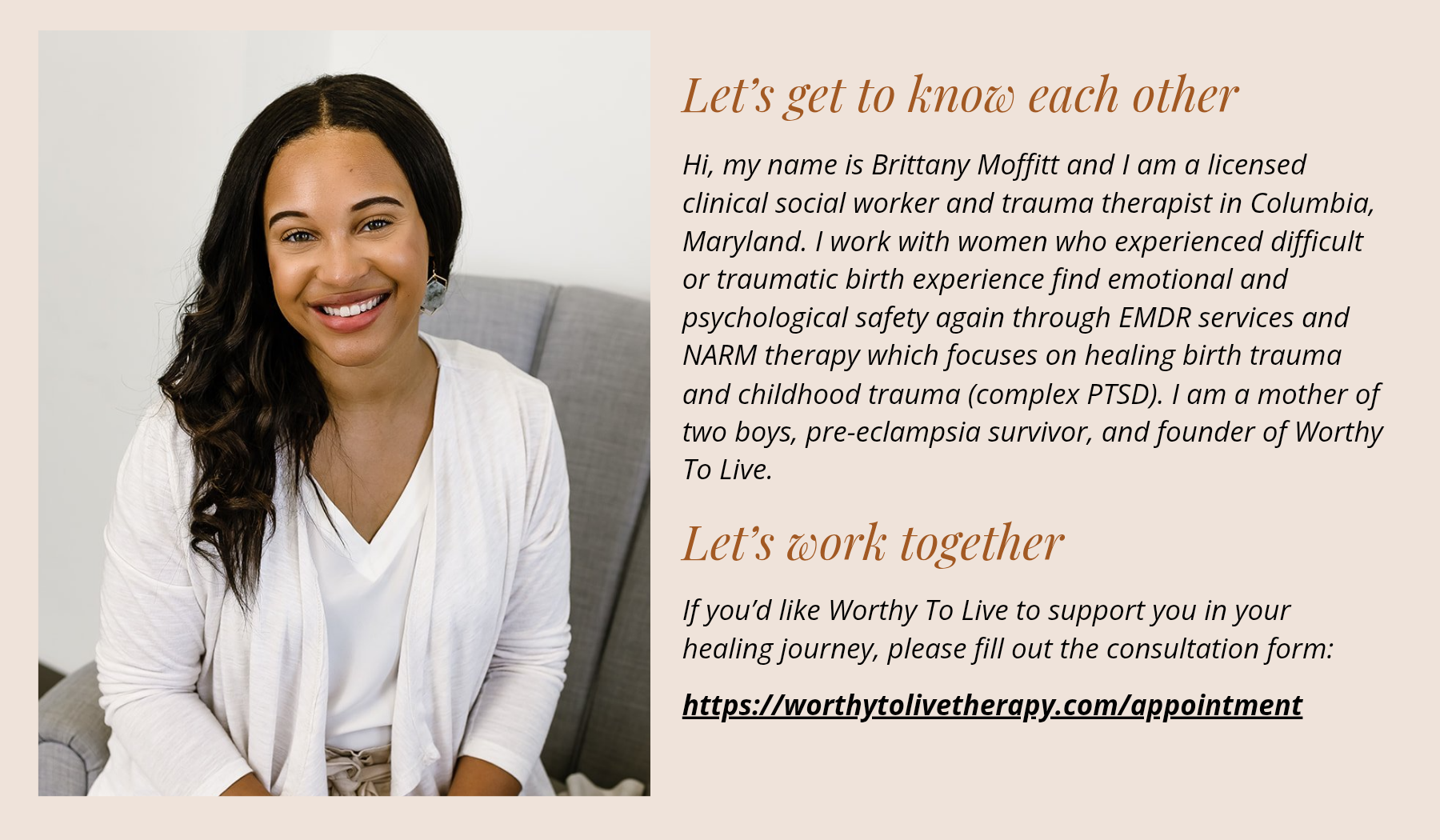
At Worthy to Live Therapy, I help mothers process birth experiences that were too much, too fast, and too overwhelming so they can enjoy their life again. We explore your birth story without having to relive every detail while also holding space for the parts of your story that feel most unresolved or activating. Healing is possible and you do not have to figure this out alone. Book a consultation to see if this feels like the right next step for you.
Until next time,
Brittany
Learn more about my therapy services here:https://worthytolivetherapy.com/individual-therapy.
Stay connected for more resources on birth trauma, postpartum mental health, and motherhood:
📱Instagram: @worthytolivetherapy
💻Facebook:https://www.facebook.com/BrittanyMoffittLICSW